Le climat est la distribution statistique des conditions de l’atmosphère terrestre dans une région donnée pendant une période donnée. L’étude du climat est la climatologie. Elle se distingue de la météorologie qui désigne l’étude du temps dans l’atmosphère à court terme et dans des zones ponctuelles. source : wikipedia
COPERNICUS – Mises à jour
Les champs auteur(e)s & mots-clés sont cliquables. Pour revenir à la page, utilisez le bouton refresh ci-dessous.



filtre:
Global warming
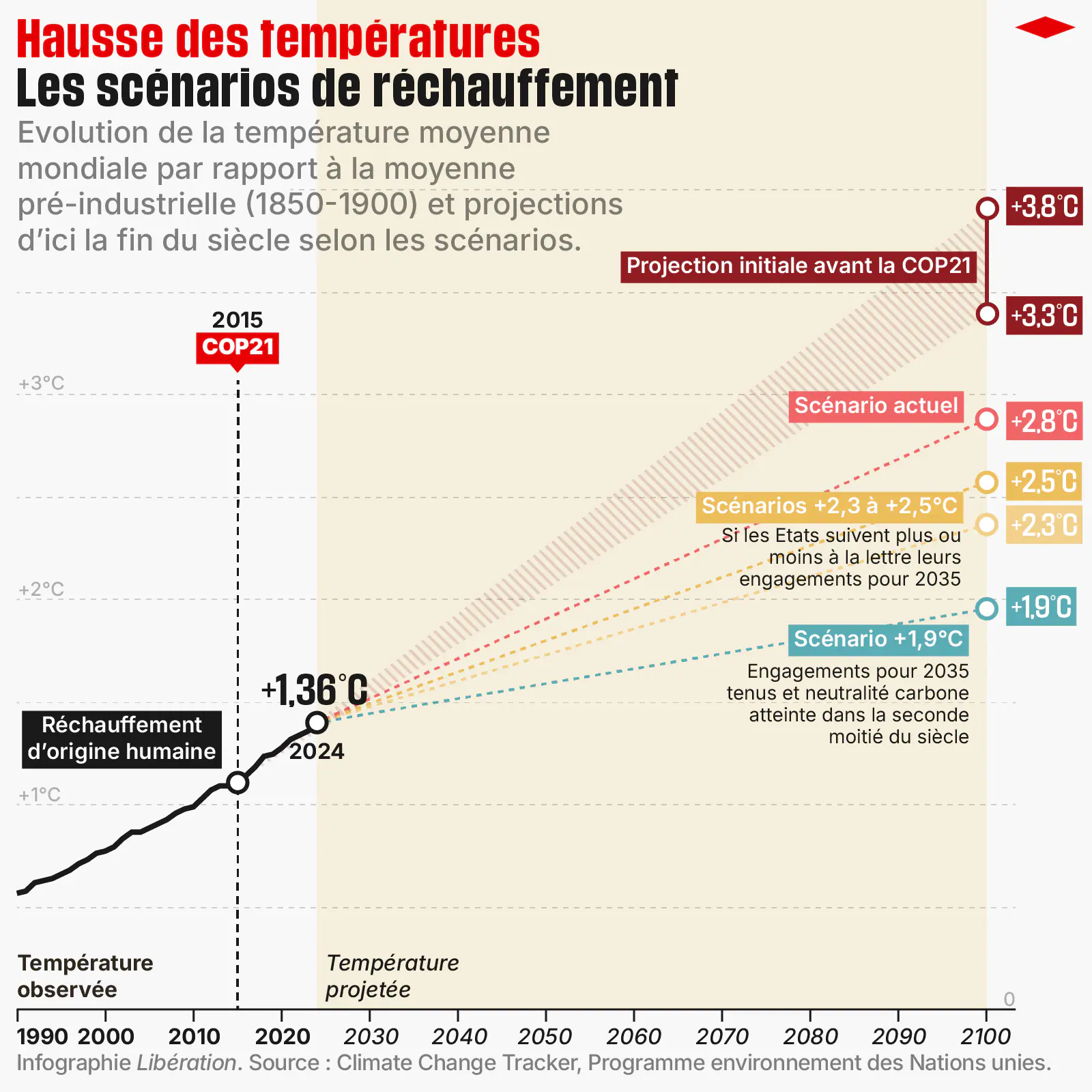
The world seems headed into another El Nino, just 3 years after the last one. Such quick return normally would imply, at most, an El Nino of moderate strength, but we suggest that even a moderately strong El Nino may yield record global temperature already in 2026 and still greater temperature in 2027. The extreme warming will be a result mainly of high climate sensitivity and a recent increase of the net global climate forcing, not the result of an exceptional El Nino, per se. We find that the principal drive for global warming acceleration began in about 2015, which implies that 2°C global warming is likely to be reached in the 2030s, not at midcentury.
The world seems headed into another El Nino, just 3 years after the last one. Such quick return normally would imply, at most, an El Nino of moderate strength, but we suggest that even a moderately strong El Nino may yield record global temperature already in 2026 and still greater temperature in 2027. The extreme warming will be a result mainly of high climate sensitivity and a recent increase of the net global climate forcing, not the result of an exceptional El Nino, per se. We find that the principal drive for global warming acceleration began in about 2015, which implies that 2°C global warming is likely to be reached in the 2030s, not at midcentury.
Global temperature in 2025 declined 0.1°C from its El Nino-spurred maximum in 2024, making 2025 the second warmest year. The 2023-2025 mean is +1.5°C relative to 1880-1920. The 12-month running-mean temperature should decline for the next few months, reaching a minimum about +1.4°C. Later in 2026, we expect the 12-month running-mean temperature to begin to rise, as dynamical models show development of an El Nino. We project a global temperature record of +1.7°C in 2027, which will provide further confirmation of the recent global warming acceleration.
German scientists warn global warming is accelerating faster than expected, raising the risk of a 3 °C rise by 2050 and forcing Europe to confront unthinkable adaptation plans.
The Production Gap Report finds that 10 years after the Paris Agreement, governments plan to produce more than double the volume of fossil fuels in 2030 than would be consistent with limiting global warming to 1.5°C, steering the world further from the Paris goals than the last such assessment in 2023.
Several, more recent global warming projections in the coupled model intercomparison project 6 contain extensions beyond year 2100–2300/2500. The Atlantic meridional overturning circulation (AMOC) in these projections shows transitions to extremely weak overturning below the surface mixed layer (<6 Sv; 1 Sv = 106 m3 s−1) in all models forced by a high-emission (SSP585) scenario and sometimes also forced by an intermediate- (SSP245) and low-emission (SSP126) scenario. These extremely weak overturning states are characterised by a shallow maximum overturning at depths less than 200 m and a shutdown of the circulation associated with North Atlantic deep water formation. Northward Atlantic heat transport at 26°N decreases to 20%–40% of the current observed value. Heat release to the atmosphere north of 45°N weakens to less than 20% of its present-day value and in some models completely vanishes, leading to strong cooling in the subpolar North Atlantic and Northwest Europe. In all cases, these transitions to a
The startup Gigablue announced with fanfare this year that it reached a historic milestone: selling 200,000 carbon credits to fund what it describes as a groundbreaking technology in the fight against climate change . But outside scientists frustrated by the lack of information released by the company say serious questions remain about whether Gigablue’s technology works as the company describes. Their questions showcase tensions in an industry built on little regulation and big promises — and a tantalizing chance to profit.
In a rapidly changing climate, evidence-based decision-making benefits from up-to-date and timely information. Here we compile monitoring datasets (published at https://doi.org/10.5281/zenodo.15639576; Smith et al., 2025a) to produce updated estimates for key indicators of the state of the climate system: net emissions of greenhouse gases and short-lived climate forcers, greenhouse gas concentrations, radiative forcing, the Earth's energy imbalance, surface temperature changes, warming attributed to human activities, the remaining carbon budget, and estimates of global temperature extremes. This year, we additionally include indicators for sea-level rise and land precipitation change. We follow methods as closely as possible to those used in the IPCC Sixth Assessment Report (AR6) Working Group One report.
The human fingerprint on global warming was likely evident in Earth’s atmosphere far earlier than previously thought—even before the invention of modern cars, a new study says. Using a combination of scientific theory, modern observations and multiple, sophisticated computer models, researchers found a clear signal of human-caused climate change was likely discernible with high confidence as early as 1885, just before the advent of gas-powered cars but after the dawn of the industrial revolution.
Recent simulations using the Community Earth System Model (CESM) indicate that a tipping event of the Atlantic Meridional Overturning Circulation (AMOC) would cause Europe to cool by several degrees. This AMOC tipping event was found under constant pre-industrial greenhouse gas forcing, while global warming likely limits this AMOC-induced cooling response. Here, we quantify the European temperature responses under different AMOC regimes and climate change scenarios. A strongly reduced AMOC state and intermediate global warming (C, Representative Concentration Pathway 4.5) has a profound cooling effect on Northwestern Europe with more intense cold extremes. The largest temperature responses are found during the winter months and these responses are strongly influenced by the North Atlantic sea-ice extent. Enhanced North Atlantic storm track activity under an AMOC collapse results in substantially larger day-to-day temperature fluctuations. We conclude that the (far) future European temperatures are dependent o
Earth’s albedo (reflectivity) declined over the 25 years of precise satellite data, with the decline so large that this change must be mainly reduced reflection of sunlight by clouds. Part of the cloud change is caused by reduction of human-made atmospheric aerosols, which act as condensation nuclei for cloud formation, but most of the cloud change is cloud feedback that occurs with global warming. The observed albedo change proves that clouds provide a large, amplifying, climate feedback. This large cloud feedback confirms high climate sensitivity, consistent with paleoclimate data and with the rate of global warming in the past century.
EN
Study Finds Synergistic Convergence of Global Warming, Pesticide Toxicity, and Antibiotic Resistance
(01/05) - Beyond PesticidesSpringtails illustrate in new research how global warning and antibiotic resistance creates synergistic effects: warming increases pesticide toxicity, triggering antibiotic resistance which spreads through horizontal gene transfer and predation.
2023 set a number of alarming new records. The global mean temperature also rose to nearly 1.5 degrees Celsius above the preindustrial level, another record.A team led by the Alfred Wegener Institute puts forward a possible explanation for the rise in global mean temperature: our planet has become less reflective because certain types of clouds have declined. The work is published in the journal Science.
We investigate the probabilities of triggering climate tipping points under five Shared Socioeconomic Pathways (SSPs) and how they are altered by including the additional carbon emissions that could arise from tipping points within the Earth's carbon cycle. The crossing of a climate tipping point at a threshold level of global mean surface temperature (threshold temperature) would commit the affected subsystem of the Earth to abrupt and largely irreversible changes with negative impacts on human well-being. However, it remains unclear which tipping points would be triggered under the different SSPs due to uncertainties in the climate sensitivity to anthropogenic greenhouse gas emissions, the threshold temperatures and timescales of climate tipping points, and the response of tipping points within the Earth's carbon cycle to global warming. We include those uncertainties in our analysis to derive probabilities of triggering for 16 previously identified climate tipping points within the Earth system.
Tipping elements within the Earth system are increasingly well understood. Scientists have identified more than 25 parts of the Earth’s climate system that are likely to have “tipping points” – thresholds where a small additional change in global warming will cause them to irreversibly shift into a new state. The “tipping” of these systems – which include the Atlantic Meridional Overturning Circulation (AMOC), the Amazon rainforest and the Greenland ice sheet – would have profound consequences for both the biosphere and people. More recent research suggests that triggering one tipping element could cause subsequent changes in other tipping elements, potentially leading to a “tipping cascade”. For example, a collapsed AMOC could lead to dieback of the Amazon rainforest and hasten the melt of the Greenland ice sheet.
Morgan Stanley, JPMorgan and an international banking group have quietly concluded that climate change will likely exceed the Paris Agreement’s 2 degree goal.Top Wall Street institutions are preparing for a severe future of global warming that blows past the temperature limits agreed to by more than 190 nations a decade ago, industry documents show.
Dozens of companies and academic groups are pitching the same theory: that sinking rocks, nutrients, crop waste or seaweed in the ocean could lock away climate-warming carbon dioxide for centuries or more. Nearly 50 field trials have taken place in the past four years, with startups raising hundreds of millions in early funds. But the field remains rife with debate over the consequences for the oceans if the strategies are deployed at large scale, and over the exact benefits for the climate. Critics say the efforts are moving too quickly and with too few guardrails.
Global temperature leaped more than 0.4°C (0.7°F) during the past two years, the 12-month average peaking in August 2024 at +1.6°C relative to the temperature at the beginning of last century (the 1880-1920 average). This temperature jump was spurred by one of the periodic tropical El Niño warming events, but many Earth scientists were baffled by the magnitude of the global warming, which was twice as large as expected for the weak 2023-2024 El Niño.
In response to global climate change, other systems, such as global oceanic circulations, could collapse, with devastating consequences. When it comes to battling climate change, some people think that the only issue we may be facing is that the climate may get a few degrees warmer. And, of course, if you live in rather cold areas on Earth, you wouldn’t mind some extra warmth. Even if you live in a temperate region, you may be inclined to think that 1.5 to 3 °C may not be such a big deal after all. […] But there is much more to climate change than warming temperatures. For example, in a previous story, I talked about how, by studying fossil records, we discovered the catastrophic chain of events following increased greenhouse gas emissions and global warming. The list goes on and on, from ocean acidification and anoxia to droughts and mass extinctions.
... An “acid” test of our interpretation will be provided by the 2025 global temperature: unlike the 1997-98 and 2015-16 El Ninos, which were followed by global cooling of more than 0.3°C and 0.2°C, respectively, we expect global temperature in 2025 to remain near or above the 1.5°C level. Indeed, the 2025 might even set a new record despite the present weak La Nina. There are two independent reasons. First, the “new” climate forcing due to reduction of sulfate aerosols over the ocean remains in place, and, second, high climate sensitivity (~4.5°C for doubled CO2) implies that the warming from recently added forcings is still growing significantly.