Le climat est la distribution statistique des conditions de l’atmosphère terrestre dans une région donnée pendant une période donnée. L’étude du climat est la climatologie. Elle se distingue de la météorologie qui désigne l’étude du temps dans l’atmosphère à court terme et dans des zones ponctuelles. source : wikipedia
COPERNICUS – Mises à jour
Les champs auteur(e)s & mots-clés sont cliquables. Pour revenir à la page, utilisez le bouton refresh ci-dessous.



filtre:
earth
La planète se mobilise pour le Earth Hour. Pendant une heure, des millions de personnes et des monuments emblématiques seront plongés dans le noir… Pour attirer l’attention sur l’urgence climatique. À Bruxelles, l’Atomium ou encore la Grand-Place participeront à cette action lancée par le WWF, qui fête cette année sa 20e édition.
When James Prescott Joule lent his name to a unit of energy, he could not have foreseen today’s alarming calculations
Paul R. Ehrlich will be remembered as a scientist whose books about population and threats to the environment shaped the idea of limited growth in the modern era.
Most research on “forever chemicals” focuses on how best to remove them from the environment. But solutions to tricky problems often emerge from the most unexpected of places—as demonstrated by a new study that instead redirects the pollutants into becoming tools for extracting precious lithium. In a recent Nature Water study, a team led by Rice University researchers describes a novel way to use spent perfluoroalkyl and polyfluoroalkyl substances, or PFAS, to recover lithium from high-salinity brine pools. The team tapped into the fluorine content inside PFAS leftovers, using it to attract lithium from briny water. Remarkably, the team was able to collect lithium fluoride at 99% purity and confirmed that the sample was pure enough to boost the stability and performance of lithium-ion batteries.
The Gulf Stream is part of the Atlantic Meridional Overturning Circulation (AMOC). The AMOC is a tipping element and may collapse under changing forcing. However, the role of the Gulf Stream in such a tipping event is unknown. Here, we investigate the link between the AMOC and Gulf Stream using a high-resolution (0. 1°) stand-alone ocean simulation, in which the AMOC collapses under a slowly-increasing freshwater forcing. AMOC weakening gradually shifts the Gulf Stream near Cape Hatteras northward, followed by an abrupt northward displacement of 219 km within 2 years. This rapid shift occurs a few decades before the simulated AMOC collapse. Satellite altimetry shows a significant (1993–2024, p < 0.05) northward Gulf Stream trend near Cape Hatteras, which is also confirmed in subsurface temperature observations (1965–2024, p < 0.01). These findings provide indirect evidence for present-day AMOC weakening and demonstrate that abrupt Gulf Stream shifts can serve as early warning indicator for AMOC tipping.
As reported by the Guardian, scientists just published a warning that Earth is approaching a point of no return. A new study in the journal One Earth shows multiple climate systems — the Greenland ice sheet, the West Antarctic ice sheet, boreal permafrost, the Amazon rainforest — are all much closer to collapse than previously thought. “Research shows that several Earth system components may be closer to destabilising than once believed,” the researchers urged. “While the exact risk is uncertain, it is clear that current climate commitments are insufficient.”
Le réchauffement a dépassé 1,5°C durant douze mois, et a peut-être déjà passé définitivement ce seuil de sécurité. Il a accéléré et a progressé dernièrement à 0,31°C par décennie, augmentant le ris…
Continued global heating could set irreversible course by triggering climate tipping points, but most people unaware
Les pesticides chimiques de synthèse sont une bombe chimique à retardement. Et cette bombe chimique est en train de décimer tout le vivant. Quand va-t-on prendre la mesure de ce qui est en train de se passer? ✴️ Dans cette nouvelle étude, entre 2023 et 2025, les scientifiques de l’Earth and Life Institute de l’UCLouvain ont échantillonné 86 parcelles agricoles en Wallonie, en analysant les 30 premiers centimètres du sol.
The world endured its costliest wildfire on record in 2025, its sixth-deadliest heat wave, and four floods or storms that caused at least 1,000 deaths.
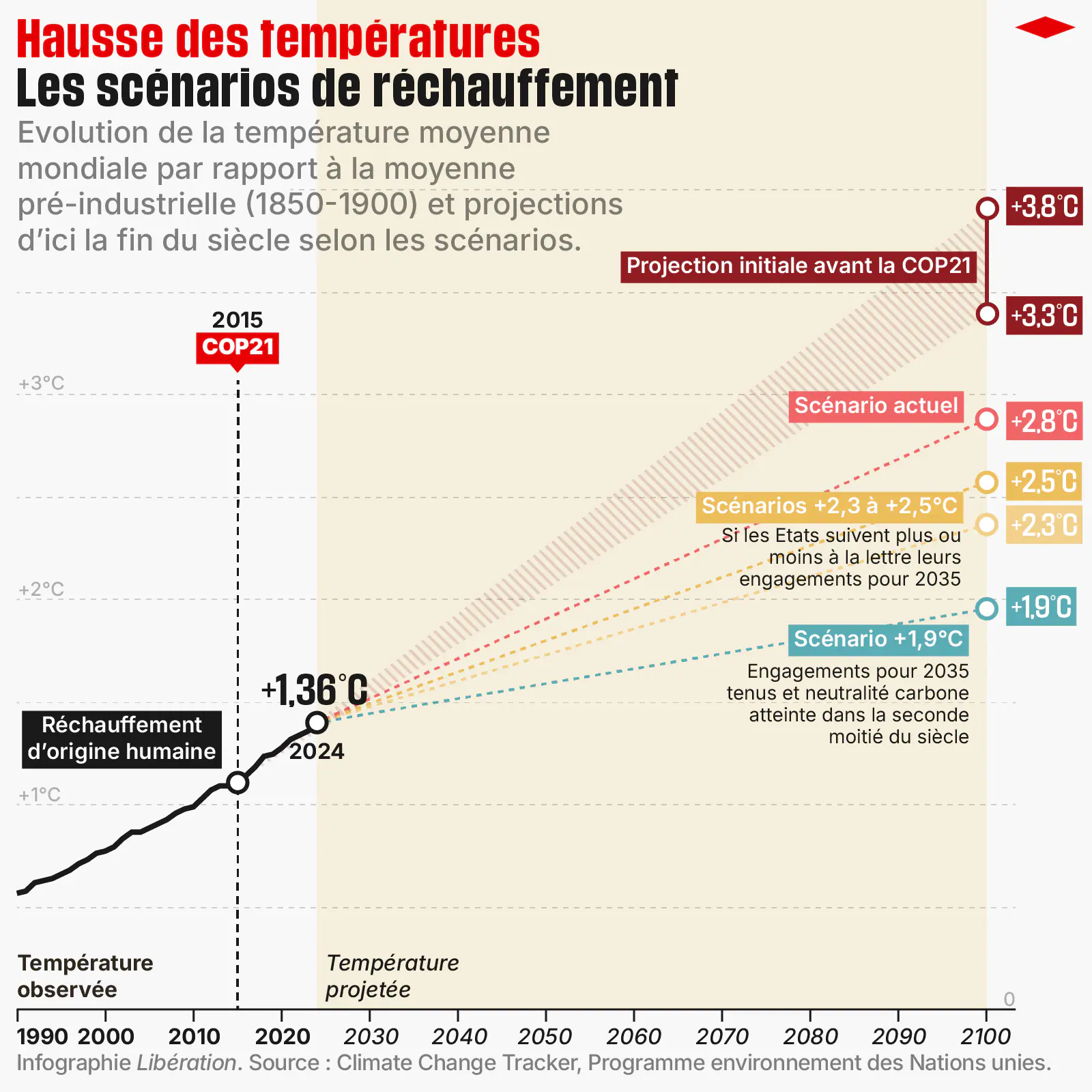
Les chiffres sont tombés mercredi, et ils sonnent comme un verdict sans appel. L’observatoire européen Copernicus et l’institut américain Berkeley Earth ont confirmé simultanément ce que de nombreux climatologues redoutaient : pour la première fois dans l’histoire des mesures, la température moyenne mondiale sur trois années consécutives dépasse de 1,5°C le niveau préindustriel. Cette limite, inscrite comme objectif le plus ambitieux de l’accord de Paris en 2015, n’était pas censée être franchie avant plusieurs décennies. Elle vient de céder en moins de trois ans.
Satellite analysis warns that widespread land subsidence threatens 1.6 billion people by 2040, with 86% of the at-risk population concentrated in Asia
L'année 2025 a été la troisième année la plus chaude jamais enregistrée dans le monde, ont annoncé mercredi l'observatoire européen Copernicus et l'institut américain Berkeley Earth, pour qui 2026 devrait rester à des niveaux historiquement hauts. Le thermomètre mondial affiche depuis trois ans des niveaux jamais vus à l'échelle de l'humanité, avec une moyenne sur la période supérieure de 1,5°C au niveau préindustriel (1850-1900), note Copernicus dans son bilan annuel. "La hausse brutale enregistrée entre 2023 et 2025 a été extrême et suggère une accélération du rythme du réchauffement climatique", estiment séparément les scientifiques de Berkeley Earth, aux Etats-Unis.
A new international analysis published in Advances in Atmospheric Sciences on 9 January finds that the Earth's ocean stored more heat in 2025 than in any year since modern measurements began. The finding is the result of a major international collaboration led by the Institute of Atmospheric Physics at the Chinese Academy of Sciences, involving more than 50 scientists from 31 research institutions worldwide. The 2025 heat increase was 23 Zetta Joules (23,000,000,000,000,000,000,000 Joules of energy), which is equivalent to ~37 years of global primary energy consumption at the 2023 level (~620 Exa Joules per year). The assessment combines data from major international data centers and independent research groups, including three observational products (Institute of Atmospheric Physics at the Chinese Academy of Sciences; Copernicus Marine; and NOAA/NCEI) and an ocean reanalysis (CIGAR-RT) from three continents: Asia, Europe, and America. These groups confirm that the 2025 ocean heat content (OHC) reached the h
The datasets used to diagnose the modern history of the planet’s climate — and to proclaim that the world is now very near to 1.5 degrees Celsius (2.7 degrees Fahrenheit) of warming — typically begin with the year 1850. The new one goes all the way back to 1781. This extended time frame matters because greenhouse gases in the atmosphere increased 2.5 percent between 1750 and 1850, enough to have caused some warming that the data hasn’t accounted for.
Glacial earthquakes are a special type of earthquake generated in cold, icy regions. First discovered in the northern hemisphere more than 20 years ago, these quakes occur when huge chunks of ice fall from glaciers into the sea. Until now, only a very few have been found in the Antarctic. In a new study soon to be published in Geophysical Research Letters, I present evidence for hundreds of these quakes in Antarctica between 2010 and 2023, mostly at the ocean end of the Thwaites Glacier – the so-called Doomsday Glacier that could send sea levels rising rapidly if it were to collapse.
Around 56 million years ago, Earth suddenly got much hotter. Over about 5,000 years, the amount of carbon in the atmosphere drastically increased and global temperatures shot up by some 6°C.
We are hurtling toward climate chaos. The planet's vital signs are flashing red. The consequences of human-driven alterations of the climate are no longer future threats but are here now. This unfolding emergency stems from failed foresight, political inaction, unsustainable economic systems, and misinformation. Almost every corner of the biosphere is reeling from intensifying heat, storms, floods, droughts, or fires. The window to prevent the worst outcomes is rapidly closing. In early 2025, the World Meteorological Organization reported that 2024 was the hottest year on record (WMO 2025a). This was likely hotter than the peak of the last interglacial, roughly 125,000 years ago (Gulev et al. 2021, Kaufman and McKay 2022). Rising levels of greenhouse gases remain the driving force behind this escalation. These recent developments emphasize the extreme insufficiency of global efforts to reduce greenhouse gas emissions and mark the beginning of a grim new chapter for life on Earth.
22 of the planet’s 34 vital signs are at record levels, with many of them continuing to trend sharply in the wrong direction. This is the message of the sixth issue of the annual “State of the climate” report. The report was prepared by an international coalition with contribution from the Potsdam Institute for Climate Impact Research (PIK) and led by Oregon State University scientists. Published today in BioScience, it cites global data from the Intergovernmental Panel on Climate Change (IPCC) in proposing “high-impact” strategies.
Four key parts of the Earth’s climate system are destabilising, according to a new study with contributions from the Potsdam Institute for Climate Impact Research (PIK). Researchers analysed the interconnections of four major tipping elements: the Greenland ice sheet, the Atlantic meridional overturning circulation (AMOC), the Amazon rainforest and the South American monsoon system. All four show signs of diminished resilience, raising the risk of abrupt and potentially irreversible changes.