Le climat est la distribution statistique des conditions de l’atmosphère terrestre dans une région donnée pendant une période donnée. L’étude du climat est la climatologie. Elle se distingue de la météorologie qui désigne l’étude du temps dans l’atmosphère à court terme et dans des zones ponctuelles. source : wikipedia
COPERNICUS – Mises à jour
Les champs auteur(e)s & mots-clés sont cliquables. Pour revenir à la page, utilisez le bouton refresh ci-dessous.



filtre:
focusclimat points bascule
Nathanaël Wallenhorst est chercheur en sciences de l’environnement, professeur à l’Université catholique de l’Ouest, et membre de l’Anthropocene Working Group. Avec «Qui sauvera la planète?» (Actes Sud, 2023), il nous exhortait à une législation forte et urgente en matière d’environnement. Il nous revient avec «2049: Ce que le climat va faire à l’Europe» (Seuil), qui explore de manière très concrète à quoi pourrait ressembler notre vie quotidienne dans 25 ans, quand les principaux «points de basculement» auront été franchis.
Et si notre Planète approchait d’un point de non-retour ? À mesure que la Terre se réchauffe, des systèmes entiers (des calottes glaciaires aux forêts tropicales) risquent de changer de manière irréversible. Ces « points de basculement » pourraient transformer le visage du monde tel que nous le connaissons. Mais faut-il pour autant céder au fatalisme ?
A l’échelle de la planète, la circulation thermohaline est régulièrement évoquée. Cependant, il existe des systèmes de courants marins plus locaux et moins connus du grand public, dont les potentiels dérèglements peuvent inquiéter. C’est notamment le cas du gyre de l’Atlantique Nord, ayant récemment fait l’objet d’une étude scientifique dont les résultats sont assez préoccupants.
Les scientifiques nous l’avaient annoncé. C’est désormais une réalité. Un tout premier point de basculement vient d’être franchi. Peut-être pas le plus sexy. Mais qui pèse au moins aussi lourd dans la balance de notre avenir à tous sur Terre.
GLOBAL TIPPING POINTS REPORT 2025 - Summary
GLOBAL TIPPING POINTS REPORT - 2025
Le monde est au seuil d’une «réalité nouvelle» sous l’effet du changement climatique dont certaines conséquences sur les récifs d’eau chaude sont probablement déjà irréversibles, alerte une étude publiée lundi 13 octobre.
Un rapport signé par 160 scientifiques, publié lundi, alerte sur la « crise sans précédent » rencontrée par les récifs coralliens d’eau chaude.
Avec l'agonie des récifs coralliens, le premier point de basculement climatique a été franchi. C'est ce qu'annoncent lundi 160 scientifiques dans le Global Tipping Points Report.
L’humanité a trop déstabilisé le climat, au point de l’avoir rapproché de « points de bascule » au potentiel cataclysmique, alertent 160 scientifiques dans un nouveau rapport.
Unless global heating is reduced to 1.2C ‘as fast as possible’, warm water coral reefs will not remain ‘at any meaningful scale’, a report by 160 scientists from 23 countries warns
Les discours politiques sont imperméables aux idées de rupture, alors que la Terre atteint ses points de bascule, selon le chercheur Nathanaël Wallenhorst. Il en va pourtant de notre survie, explique-t-il.
A quoi ressemblerait notre vie quotidienne, en 2049, sur une Terre qui franchirait les principaux points de basculement ? Fort de savoirs sans cesse actualisés, Nathanaël Wallenhorst anticipe d’une façon très concrète ce que pourrait être 2049 côtés écosystème, climat et société. Aurons-nous toujours des saisons en 2049 ? De quoi sera faite notre alimentation ? Quels seront nos loisirs ? Climat, eau, santé et migrations, l’auteur raconte notre quotidien dans ce futur proche si rien ne change.
Affaibli par le dérèglement climatique, l’AMOC aurait bien plus de chances de s’arrêter que prévu, avertit une nouvelle étude. Un événement littéralement glaçant puisqu’il ferait chuter les températures en Europe jusqu’à –30 °C.
There is rising concern that several parts of the Earth system may abruptly transition to alternative stable states in response to anthropogenic climate and land-use change. Key candidates of such tipping elements include the Greenland Ice Sheet, the Atlantic Meridional Overturning Circulation, the South American monsoon system and the Amazon rainforest. Owing to the complex dynamics and feedbacks between them via oceanic and atmospheric coupling, the levels of anthropogenic forcing at which transitions to alternative states can be expected remain uncertain. Here we demonstrate how such interactions can generate spurious signals and potentially mask genuine signs of destabilization. We further review and present observation-based evidence that the stability of these four tipping elements has declined in recent decades, suggesting that they have moved towards their critical thresholds, which may be crossed within the range of unmitigated anthropogenic warming. Our results call for better monitoring of these ti
Despite working on polar science for the British Antarctic Survey for 20 years, Louise Sime finds the magnitude of potential sea-level rise hard to comprehend
The planet is edging close to irreversible change, according to the most comprehensive probability analysis yet of climate “tipping points.”
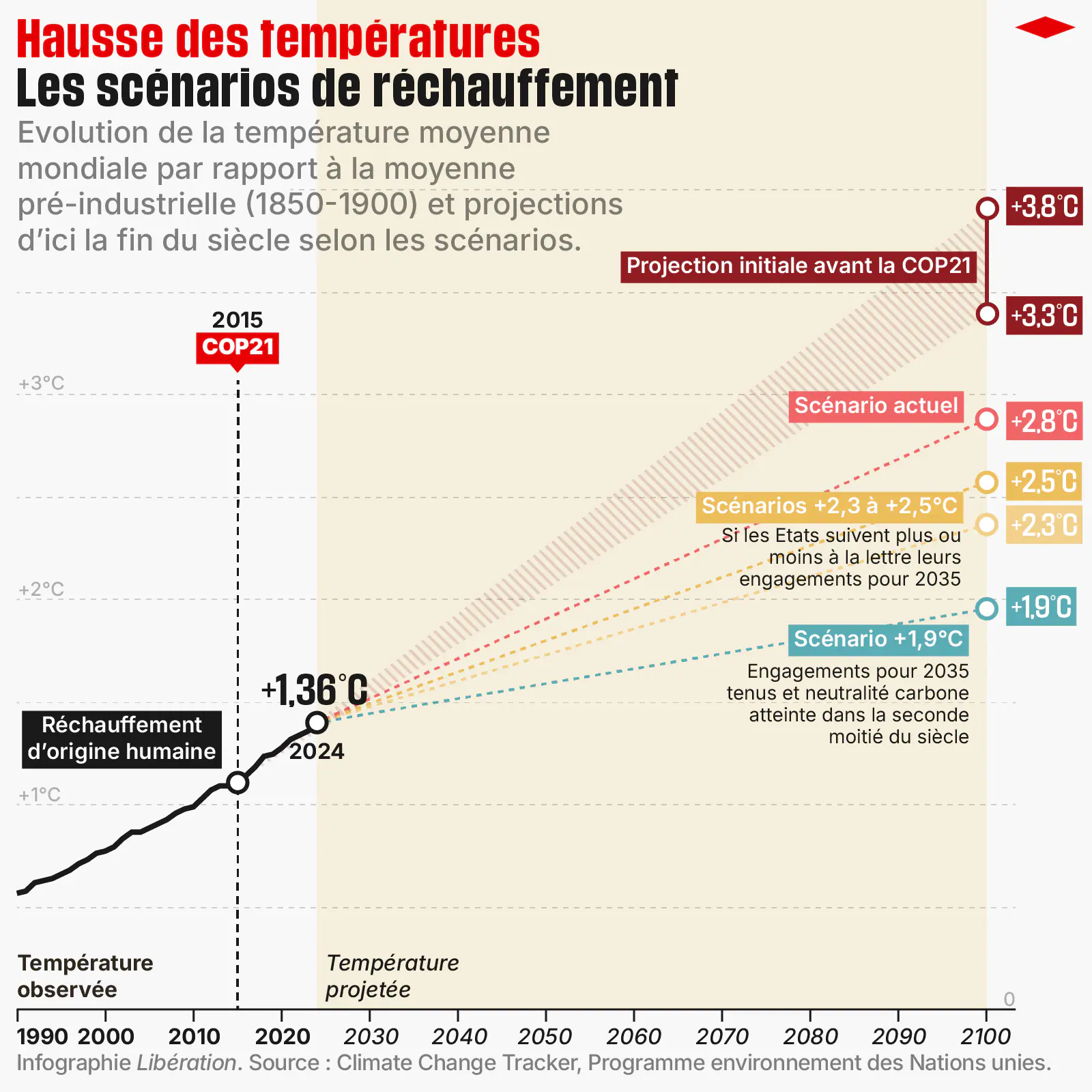
De multiples "points de basculement" climatiques sont susceptibles d'être déclenchés si les politiques mondiales restent sur leur cours actuel, selon de
We investigate the probabilities of triggering climate tipping points under five Shared Socioeconomic Pathways (SSPs) and how they are altered by including the additional carbon emissions that could arise from tipping points within the Earth's carbon cycle. The crossing of a climate tipping point at a threshold level of global mean surface temperature (threshold temperature) would commit the affected subsystem of the Earth to abrupt and largely irreversible changes with negative impacts on human well-being. However, it remains unclear which tipping points would be triggered under the different SSPs due to uncertainties in the climate sensitivity to anthropogenic greenhouse gas emissions, the threshold temperatures and timescales of climate tipping points, and the response of tipping points within the Earth's carbon cycle to global warming. We include those uncertainties in our analysis to derive probabilities of triggering for 16 previously identified climate tipping points within the Earth system.
Tipping elements within the Earth system are increasingly well understood. Scientists have identified more than 25 parts of the Earth’s climate system that are likely to have “tipping points” – thresholds where a small additional change in global warming will cause them to irreversibly shift into a new state. The “tipping” of these systems – which include the Atlantic Meridional Overturning Circulation (AMOC), the Amazon rainforest and the Greenland ice sheet – would have profound consequences for both the biosphere and people. More recent research suggests that triggering one tipping element could cause subsequent changes in other tipping elements, potentially leading to a “tipping cascade”. For example, a collapsed AMOC could lead to dieback of the Amazon rainforest and hasten the melt of the Greenland ice sheet.